The Scandalous History of Clontarf: Defamation and Orgies

Clontarf was at the centre of a scandal in the late 19th century when allegations of debauchery at its pleasure grounds led to one of the most sensational defamation cases in colonial Australia. The legal battle, fuelled by accusations of immorality, tested the limits of press freedom and exposed the social tensions of the time.

The Rise of Clontarf Pleasure Grounds

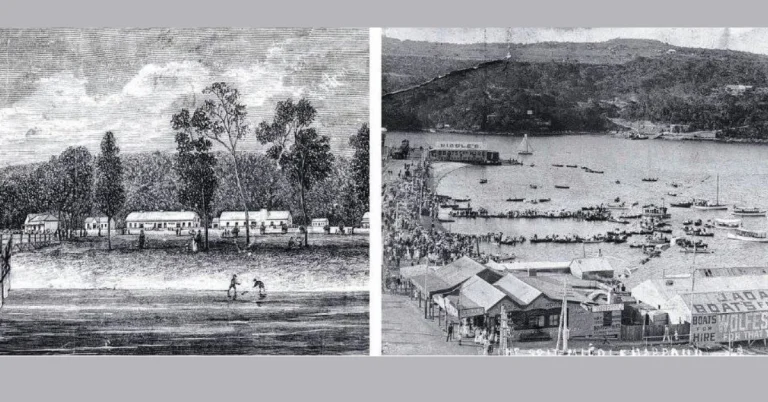
By the 1870s, Clontarf Pleasure Grounds had become one of Sydney’s most popular harbour picnic destinations. Situated on the northern foreshore, it was accessible primarily by ferry, attracting thousands of visitors—sometimes up to 5000 on a public holiday. The grounds offered games like quoits and skittles, but the main draw was the dancing, drinking, and live music performed in licensed halls, where rum and brandy were the beverages of choice.

However, as crowds of young people flocked to Clontarf, concerns grew over the behaviour fuelled by alcohol and excitement. By 1881, the venue’s reputation took a serious hit when The Bulletin published a damning report. The report sparked an intense defamation lawsuit.

Clontarf Pleasure Grounds
Caption: Clontarf Pleasure Grounds from Mosman (1905)
Photo Credit: Northern Beaches History Hub

The Defamation Case That Gripped Sydney

In December 1881, The Bulletin printed an article by journalist William Traill, who described the previous Boxing Day celebrations at Clontarf as nothing short of an orgy. He wrote of intoxicated men and women, their “blood warmed by alcohol and their passions inflamed,” engaging in “romping abandon” and indecent dancing, likening the scene to that of “satyrs and bacchantes,” describing them as being “in soiled suits and squalid finery.”

Enraged by these descriptions, Clontarf’s proprietors, William and Thomas Moore, sued The Bulletin for libel, demanding £1000 in damages.

The trial was a spectacle, drawing widespread public attention across Australia. Witnesses for the Moores—employees, friends, and junior policemen—acknowledged drunkenness and fights but insisted that it was not an orgy. However, The Bulletin’s defence presented lurid accounts of public brawls, swearing, underage drinking, and inappropriate conduct, including a man wearing a woman’s drawers and groups of naked bathers being watched by onlookers.

Senior policemen also weighed in, claiming that two-thirds of the prostitutes they knew had been led to ruin by pleasure grounds like Clontarf.

After heated legal arguments, the jury ruled in favour of the Moores, but in a symbolic move, they awarded only one farthing in damages, a moral victory for The Bulletin.

Clontarf defamation case
Caption: Jules Archibald and John Haynes 
Photo Credit: Wikimedia Commons

The Fallout and Press Freedom Debate

Despite the symbolic damages, The Bulletin’s proprietors, John Haynes and Jules Archibald, were ordered to cover the Moores’ legal costs of more than £1500. Unable to pay, they were jailed in Darlinghurst for a year, igniting a public backlash. A fundraising campaign quickly gained momentum, securing their release within weeks.

The case sparked a national debate on press freedom, particularly the right of journalists to expose social controversies and the broader implications for defamation law reforms in Australia.

While The Bulletin continued its fearless journalism, Clontarf’s reputation suffered. By the turn of the century, the pleasure grounds faded into obscurity, never fully recovering from the scandal that had once made them infamous.

Updated 8-Dec-2025

Clontarf Tidal Pool Undergoes Upgrade

Now at the end of its life, the 1940s-built Clontarf Tidal Pool undergoes rebuilding, making it longer, wider and better for present and future generations to enjoy.


Opened in 1949, Council said that the existing tidal pool is at the end of its life and hence needs to be rebuilt. Made possible by a grant under the NSW State Government Public Spaces Legacy Program, the $542,000 upgrade of the tidal pool at Clontarf Beach will be commencing this March 2023.

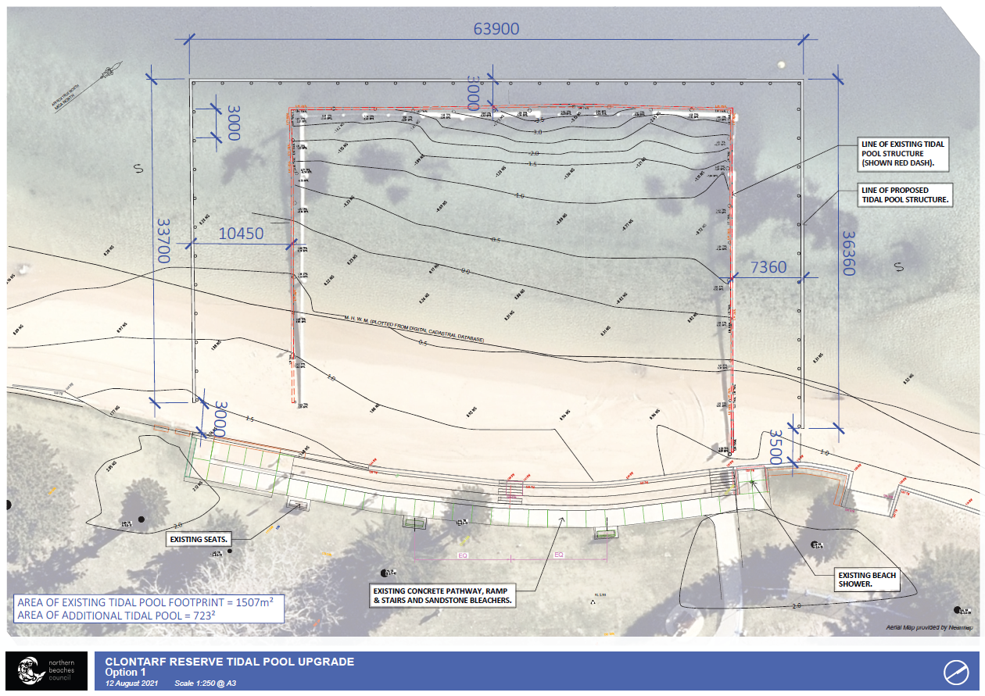
The upgrade will look similar to the upgraded tidal pool at Little Manly and will see the pool enlarged to improve user experience, cater for population growth and align with other elements in the park Masterplan. The pool will offer lap swimming in deeper water on lower tides as its width increases by three metres into the harbour. 

Clontarf Tidal Pool will look similar to the upgraded tidal pool at Little Manly |
Clontarf Tidal Pool will look similar to the upgraded tidal pool at Little Manly | Photo credit:  Northern Beaches Council / yoursay.northernbeaches.nsw.gov.au

The pool’s length will also be increased to 64 metres to provide a more protected wading area and shoreline to cater for heavy use periods and future increases in usage. 

Also, the pool enclosure finishes a minimum of 3 metres from the existing seawall to allow beach rake access into the pool and adjacent beach for cleaning, and also maintains pedestrian access along the beach.

Concept plan | Photo credit:  Northern Beaches Council / yoursay.northernbeaches.nsw.gov.au

More durable materials will be used for the upgrade for less maintenance and less disturbance to the marine environment in the long-term, including the use of timber walers around the pool, HDPE-sleeved steel piles and high-strength shark netting.


Resident seahorses were relocated in late February  to purpose made seahorse hotels following approval by the Department of Primary Industry (Fisheries). Construction is expected to be completed by September 2023, in time for the seahorse breeding season.

Published 16-March-2023

Exploring Contarf’s Grotto Point Aboriginal Engraving Site

Immerse yourself in Sydney’s rich Aboriginal heritage by visiting Clontarf’s Grotto Point Aboriginal engraving site.

Have you ever wondered what life must have been from our ancestors’ point of view? Good thing there are a few remnants that have survived over the century that currently allow us to have a glimpse of the past. It is also fortunate that there are numerous Aboriginal archeological sites found within Sydney’s region, which makes it even more accessible for all.

At the Sydney Harbour National Park lies one of Sydney’s historic rock art with scenic views, the Grotto Point Aboriginal engraving site. This is located specifically within the park at Dobroyd Head.

Grotto Point Engraving
Photo credit: www.nationalparks.nsw.gov.au

Grotto Point is considered to be one of the best places for locals and tourists to see historical rock engravings up close. The engravings are fascinating and well preserved. Even the site itself has added timber enclosures that surround all the engravings in order to further protect them.

Up close, you get to see various engravings such as people, animals- fish, sharks, and kangaroo, different geometric designs, and boomerangs. Also, there are informative signs found within the site to help you learn more about these Aboriginal engravings.

Aboriginal Engraving
Photo credit: https://www.atnf.csiro.au/

The engravings found at Grotto Point are said to be 1000 years old, and they were originally made by connecting a series of holes from sharp edges of hard rocks and other quartz tools.

The engravings found at the Grotto Point represent Aboriginal mythology and their spirituality. However, it must be noted that even though some of these engravings are quite similar to the ones found in other historical sites, the meaning of these engravings still varies.

Given the site’s close proximity to the available Grotto Point walking track, and as well as the high visitation of tourists each day, the site is no longer used for traditional ceremonial practices. But some of the remaining descendants of traditional families still maintain the site’s ceremonial significance up until today.

Enjoy a Relaxing Dining Experience at This Clontarf Beach Restaurant

Have a great dining experience along Clontarf Reserve at Clonny’s on the Beach.

Are you looking for a place to set up a casual brunch with your family and friends? Head over to Clonny’s on the Beach at Clontarf Reserve today and check out their delicious offerings.

Clonny’s on the Beach is a multi-cuisine restaurant managed by Chef Jo Bright and her colleagues, Steve Lee and Chris Dearberg. The restaurant is set against the beautiful backdrop of Clontarf Reserve, making it an ideal venue for catering large groups or functions for any special occasion. Walk-ins are welcome too at this restaurant.

The menu includes freshly produced entrees and dishes for breakfast and lunch only. Kids’ menu is available, as well as some vegetarian, vegan, and gluten- free food options.

Clonny's on the Beach
Baked eggs with chorizo
Photo credit: Clonny’s on the Beach/ Facebook
Clonny's on the Beach
Dine in reservation at Clonny’s on the Beach
Photo credit: Clonny’s on the Beach/ Facebook


Aside from the restaurant, Clonny’s also has a Kiosk that is perfect for those who are on the go.

The kiosk offers freshly served meals, snacks, and coffee that is ready for pick up for patrons who want to grab a quick food or drink, and enjoy it under the shade of an umbrella or over a picnic by the park or by the beach.

The kiosk offers salads, burgers, fish and chips, ice cream, coffee, and more!

Clonny's Kiosk
Burger and Coffee at the kiosk
Photo credit: Clonnys at Clontarf/ Facebook
Clonny's Kiosk
Salad and snacks at the kiosk
Photo credit: Clonnys at Clontarf/ Facebook

Who would not want a quick snack whilst going around Clontarf Reserve’s facilities? It is a good thing that both Clonny’s on the Beach and Clonny’s Kiosk are nearby!


The operating hours for the restaurant and the kiosk are as follows:

Clonny’s on the Beach
Saturday & Sunday8:00 a.m. – 3:00 p.m.
Clonny’s Kiosk
Monday- Friday9:00 a.m. – 3:00 p.m.
Saturday & Sunday9:00 a.m. – 4:30 p.m.

For bookings you may send your request via email at bookings@clonnys.com.au.

Click here to know more about their latest offerings.

Sandy Bay: Clontarf’s 24 Hour Puppy Beach

Head over to Clontarf’s Sandy Bay this weekend and enjoy a nice dip in the water with your pooch!

Sandy Bay at Clontarf Reserve is one of the Lower North Shore’s dog friendly beaches. It is located north of Clontarf on Sandy Bay Road providing access to Middle Harbour. Sandy Bay also faces southeast towards The Spit that is only 500 meteres away.

Sandy Bay
Photo credit: dogfriendlynsw.blogspot.com

Sandy Bay is a 120 metre wide sheltered bay with shallow clean water that is ideal of pups (and people) who are not yet confident in deep waters with waves. Good swimmers may also opt to swim further in the calm waters of Sandy Bay for their enjoyment.

The shore space is a bit small at high tide, but any time other than the peak high tide hour will still give you enough space for you and your pooch to run, swim, and play. Low tide is still the best time for you to do some fun sand activities with your pet whether it is ball chasing or sand rolling.

Dog Beach
Photo credit: dogfriendlynsw.blogspot.com

Other facilities in Sandy Bay include an off-leash dog walking area, dinghy storage area, and waste bins. There are a few official parking spaces available for free, but on a busy day people may also park on the road edge. The nearest public toilet is 500 metres away from the beach at Clontarf Reserve.


If you are planning on visiting Sandy Bay, keep in mind that this dog friendly beach is a busy spot especially during weekends. Heaps of dog walkers come in this area during the week, and there are plenty of pooches of all sizes on a nice weekend day.

For food and drinks, you may either have a BYO picnic and have it under one of the shaded areas in the reserve, or you may also walk over to some of the kiosks found at Clontarf Reserve afterwards.